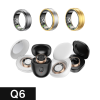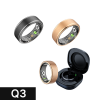

From rustic wood to gleaming gold—if we can customize phone cases and watch bands, why does every smart ring seem to come in the same two materials?
The appeal of a smart ring is its intimacy: a piece of technology worn constantly. It’s natural to want it to reflect personal style. At Xuanzhi, makers of the SHR Ring K3, we’re often asked: “Can I get this in a different material?” The answer is more nuanced than a simple yes or no. Let’s explore the engineering reality behind smart ring customization.
First, it’s crucial to understand that a smart ring is a miniaturized electronic health device first and a piece of wearable fashion second. The housing is not just a shell; it’s a critical functional component. This imposes non-negotiable requirements that severely limit material options:
Signal Transparency: The material must not block the optical signals for the PPG sensor (which reads blood flow for heart rate/SpO2) or the RF signals for Bluetooth connectivity. Dense metals and certain composites can act as a “Faraday cage,” rendering the device useless.
Sensor Coupling: The inner surface must allow for perfect, consistent skin contact for the biometric sensors. A porous or irregular material would create air gaps, corrupting data accuracy.
Heat Dissipation & Biocompatibility: It must safely dissipate minimal heat from electronics and be hypoallergenic for 24/7 skin contact.
This is why the market is dominated by two categories: medical-grade metals (like the titanium in the SHR Ring K3) and specialized ceramics. They uniquely meet these baseline engineering needs.
While a fully bespoke ring from a blank slate isn’t feasible for a functional device, customization exists on a spectrum. Here’s what’s technically possible versus what’s commonly offered:
| Customization Level | What It Entails | Feasibility & Impact |
|---|---|---|
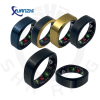
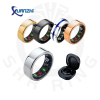
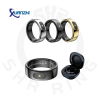
| Color/Finish | PVD coatings, anodization, polished vs. matte surfaces. | High. This is the most common. The K3, for instance, offers distinct finishes. It’s a cosmetic layer over a standard base material. |
| Size/Width | Offering multiple ring widths and a full range of sizes. | High. A logistical rather than engineering challenge. Crucial for comfort and sensor accuracy. |
| Material Grade | Using a higher grade of the same base material (e.g., aerospace vs. commercial titanium). | Moderate. Impacts cost, weight, and feel, but not core functionality. Often a brand’s strategic choice. |
| Swap-able Outer Shells | A core module with interchangeable decorative bands. | Conceptually possible, but rare. Adds complexity, bulk, and potential for sensor misalignment. |
| Full Material Change | Building the same electronics into a housing of gold, tungsten, carbon fiber, etc. | Very Low to Impossible. Most materials fail the signal transparency or manufacturability test. Would require a complete device re-engineering for each option. |
Let’s examine why some attractive materials aren’t used:
Solid Gold/Platinum: Extremely dense, would block all sensor and wireless signals. Also, malleability could damage internal components. Verdict: Impossible for a full housing.
Stainless Steel (common in jewelry): More feasible than precious metals, but still can interfere with signals. Often requires complex antenna design, increasing cost and size. Verdict: Difficult and inefficient.
Wood/Resin: Porous, poor skin contact for sensors, lacks structural integrity, and sensitive to moisture. Verdict: Functionally incompatible.
Carbon Fiber: Electrically conductive, which would severely disrupt Bluetooth and potentially create a “noisy” environment for sensitive biosensors. Verdict: A deal-breaker for electronics.
Sapphire Crystal: Excellent for watch faces due to scratch resistance, but prohibitively expensive and brittle for a full ring housing. Machining it into a complex shape with sensor ports is a monumental challenge. Verdict: Economically and technically unviable.
For the SHR Ring K3, our design process asked: “What material provides the ideal balance of durability, signal transparency, biocompatibility, and value?”
The answer was Grade 5 Titanium. Here’s why it’s our optimized, standardized choice:
The Performance Standard: It meets every technical requirement perfectly, ensuring the health data you rely on is accurate.
The Value Proposition: Standardization allows for precision manufacturing at scale. This is a key reason the K3 can be offered at $28 while maintaining quality. Introducing material variants would fragment production and multiply costs.
Durability First: Titanium offers the best strength-to-weight and toughness profile for a device designed for 24/7 life. We prioritized this over offering more delicate or niche material options.
In essence, we “customized” the product at the design phase for the broadest set of real-world needs: active lifestyles, reliable data, and accessible pricing. The ring’s form is a direct result of its function.
While you can’t order a walnut K3, you do have meaningful choices:
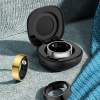
Choose a Brand That Offers Multiple Finishes: Look for PVD coatings (like the K3’s black or gold options) which are highly durable and change the aesthetic significantly.
Accessorize Around It: The true customization lies in how you wear it. The neutral, low-profile design of devices like the K3 allows them to complement other jewelry rather than clash with it.
Prioritize the Data, Not the Shell: Remember the primary purpose. A perfect material match for your pinky toe is irrelevant if the ring can’t accurately track your sleep stages or recovery. Choose for sensor performance first.
The most profound “customization” a smart ring offers is not of its metal, but of your health. The data it provides allows you to build a lifestyle uniquely tailored to your body’s needs—a form of personalization far more valuable than a choice of alloy.
Discover the Intelligently Designed Standard
The SHR Ring K3 is built with a purpose-driven material choice, ensuring you get reliable health insights without paying for impracticable customization.
[Explore the SHR Ring K3 in Titanium – $28]
✅ Optimized Grade 5 Titanium Housing
✅ Multiple Durable Finishes Available
✅ Focused on Accuracy & Value
Xuanzhi: Making clear, engineered choices so you can focus on what the data tells you, not what the ring is made of.