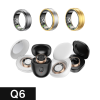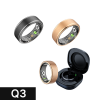

When your finger develops a rash, itching, or even peeling, it’s not a “detox” process—it’s your smart ring sending a material quality warning.
While pursuing better health, suffering from contact dermatitis due to wearing a smart ring is undoubtedly ironic. At Xuanzhi, the parent company of SHR Ring, we believe that safety is the foundation of health. This article reveals the real culprits behind smart ring allergies and guides you in choosing a truly safe product like the K3 Smart Ring.
The Main Culprit: Low-Q Metal Plating
Many low-cost smart rings use alloys with excessive nickel content as the base material, coated with only a thin layer of “hypoallergenic” plating. Once sweat corrodes or daily wear damages the coating, nickel ions directly contact the skin, triggering severe allergic reactions. Nickel is one of the most common contact allergens worldwide.
The Accomplice: A Damp, Enclosed Environment
The space between the ring and skin creates a sealed environment where sweat, soap, lotion, and dust accumulate. If the ring is poorly designed, has a rough interior, or lacks breathability, these irritants continuously aggravate the skin, breaking down its barrier and increasing the risk of allergies and infections.
The Hidden Enemy: Poor Craftsmanship & Corrosion
Rough edges can constantly rub against the skin, causing micro-injuries that allow allergens to penetrate. Additionally, metals around charging ports or sensors that are prone to corrosion can release metallic salts, further irritating the skin.
Keep these four points in mind to avoid all pitfalls:
Medical-Grade Materials: The Inner Surface Matters
Don’t just focus on the external material. Always ask what material touches your skin directly.
Best Choice: Implant-Grade Titanium. Widely used in artificial joints and cardiac stents, it offers exceptional biocompatibility, contains no nickel or vanadium, and is highly corrosion-resistant.
Good Alternative: Medical-Grade 316L Stainless Steel. Ensure it meets medical standards with low nickel release rates.
Avoid: Any product labeled simply as “alloy” without detailed material information.
Examine Design & Craftsmanship: Details Make the Difference
Seamless Construction: Choose a ring with a smooth, one-piece interior to prevent dirt buildup and skin irritation.
Breathability: Look for an ergonomic design with grooves or curves that allow air circulation and sweat evaporation.
Smooth Finishing: Edges must be polished to perfection, with no sharp or rough surfaces.
Check Protection Ratings: Resilience Against Sweat & Daily Life
Ensure the ring has an IP68 or higher rating. This not only allows worry-free swimming and handwashing but also proves its sealed structure prevents sweat and moisture from corroding internal components—a key cause of allergies.
At Xuanzhi, we believe true health technology should never compromise comfort or safety. That’s why we engineered the K3 Smart Ring with allergy prevention as a core principle:
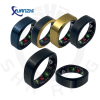
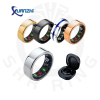
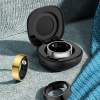
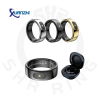
Materials: The K3 ring body is crafted from Grade 5 Titanium (Ti-6Al-4V ELI), the same material used in surgical implants. It’s completely free of nickel and vanadium, eliminating metal allergies at the source. All coatings (e.g., black, gold) use eco-friendly PVD plating, which is durable and resistant to chipping.
Design: The K3 features a seamless, unibody design. Its interior is precision-machined and hand-polished to a mirror-like smoothness, ergonomically shaped to avoid pressure points and debris accumulation.
Durability: With an IP68 waterproof rating, the K3 withstands sweat, handwashing, swimming, and more. Its internal electronics are fully encapsulated, ensuring skin contact only with pure, medical-grade titanium.
Sizing: We offer a full range of sizes from 6 to 13 (in Obsidian Black, Titanium Silver, and Champagne Gold) and provide a free sizing kit to ensure a snug yet comfortable fit—preventing friction and sweat buildup caused by improper sizing.
Health Note: If you have a known severe metal allergy, consult a doctor before wearing any jewelry. While the K3 uses ultra-hypoallergenic materials, we cannot guarantee 100% allergy prevention for every individual.
Choosing a smart ring means selecting a 24/7 health partner. Its first duty is to be harmless, then helpful. A ring that causes allergies has already failed its primary purpose, regardless of its features.
Investing in a product like the SHR Ring K3—engineered for safety from materials to design—is not only a commitment to your skin’s health but also an investment in reliable, long-term health data.